Could a Solar Storm Really Collapse Modern Civilization?
- Tommy Forsberg
- Mar 8
- 6 min read

Updated: Mar 18

How extreme space weather can disrupt power grids, satellites, GPS, communications, and modern infrastructure.
Yes, a severe solar storm could damage enough critical infrastructure to trigger major blackouts, communications failures, navigation problems, and supply chain disruption. It would not necessarily destroy every electronic device on Earth, but it could disrupt the systems modern civilization depends on most.
It could do serious damage. That is the honest answer.
Not because the Sun has finally had enough of us and decided to settle the score. The Sun is not petty. The problem is that modern civilization depends on a delicate mesh of electricity, satellites, timing signals, communications networks, and supply chains. When enough of those systems fail at once, daily life stops being modern surprisingly quickly. NOAA notes that geomagnetic storms can disrupt GNSS navigation, affect spacecraft, and create harmful geomagnetically induced currents in power systems.
What is a solar storm?
A major solar storm usually begins with intense solar activity, such as a solar flare or a coronal mass ejection, often shortened to CME. A CME is a vast cloud of magnetized plasma thrown off by the Sun. If it is directed toward Earth, it can disturb Earth’s magnetic field and trigger a geomagnetic storm. That can affect the ionosphere, satellites, radio communications, navigation systems, and electrical infrastructure.
Most of the time, the result is dramatic aurora and some technical headaches for forecasters, satellite operators, and people who would rather their navigation systems continue behaving like navigation systems. During stronger events, the consequences can be more serious. The Met Office lists risks to power grids, communications, GNSS, spacecraft, and aviation during major space weather events.
Has this happened before?
Yes, though not in a fully electrified and satellite-dependent world like ours.
The most famous benchmark is the Carrington Event of 1859, the strongest recorded geomagnetic storm in modern history. It disrupted telegraph systems badly enough to shock operators and interfere with equipment. More recently, NASA has highlighted the July 2012 near-miss, an extreme CME that missed Earth but was powerful enough that a direct hit could have caused widespread power blackouts and severe technological disruption.
That is the unsettling part. This is not a purely theoretical hazard cooked up by novelists in dark rooms. It is a real class of event studied by space weather agencies, grid operators, and governments.
Would everything fail at once?
Probably not, and that is important.
A severe solar storm is more likely to cause an uneven, cascading crisis than a perfectly synchronized global blackout. Some systems are more exposed than others. Some regions are more vulnerable than others. Grid design, latitude, equipment hardening, backup capacity, operator response, and simple luck all matter. NERC’s geomagnetic disturbance material focuses on transformer saturation, reactive power issues, harmonics, and voltage instability in bulk power systems, which is a more complicated and less cinematic process than every light on Earth dying in the same dramatic second.
In other words, reality is messier than the movies. It usually is.
What systems are most vulnerable?
The biggest concerns are not your toaster staging a final act of rebellion. They are the large, invisible systems that keep modern life coordinated.
Power grids
One of the most serious risks comes from geomagnetically induced currents flowing through long transmission systems. These currents can stress transformers, consume reactive power, generate harmonics, and in severe cases contribute to voltage instability and equipment damage. NERC and NOAA both identify bulk power systems as a major concern during extreme geomagnetic activity.
Satellites and spacecraft
Satellites are exposed to charging effects, radiation hazards, signal degradation, and increased atmospheric drag during geomagnetic storms. NASA and NOAA both note that severe space weather can damage satellite electronics and disrupt operations.
GPS and other navigation systems
Geomagnetic storms disturb the ionosphere, which can degrade GNSS accuracy and reliability. NOAA notes that GPS errors can increase significantly during major storms, especially at high latitudes but also beyond them in stronger events. That matters not just for drivers, but for aviation, shipping, telecom timing, and parts of financial infrastructure.
Radio communications and aviation
Large solar events can disrupt HF radio, which is still important for aviation and maritime communication, especially in high-latitude and oceanic operations. The Met Office specifically notes the importance of space weather forecasting for high-latitude flights and for communication reliability.
So could civilization actually collapse?
That depends on what one means by collapse.
If collapse means that every chip on Earth dies forever and humanity is instantly reduced to campfires and mutual suspicion by lunchtime, that is probably an overstatement.
If collapse means widespread blackouts, damaged satellites, impaired navigation, broken communications, severe supply chain disruption, water and fuel problems, and social instability spreading faster than repairs can keep up, then yes, that is a serious and plausible concern. NASA’s 2012 near-miss article specifically notes that an extreme direct hit could cause widespread power blackouts and disable systems that depend on wall power.
And that is before the secondary effects begin. Modern societies are not only powered by electricity. They are powered by coordination. Food distribution, fuel delivery, refrigeration, digital payments, water pumping, transportation logistics, and emergency response all depend on systems talking to one another. Once enough of that quiet coordination breaks, the crisis stops being technical and becomes human.
Would some places fare better than others?
Almost certainly.
A severe solar storm would not create one identical experience for everyone. Communities with local resilience, practical skills, backup energy, stored food, and less dependence on fragile digital systems would likely fare better than large urban areas built on constant external supply and just-in-time delivery. That does not make rural life easy. It simply means the damage would be uneven, and uneven crises are often the hardest to understand while they are happening.
One place might go dark immediately. Another might limp along just enough to believe things are under control. That false sense of normality can be its own kind of trap.
What about the aurora?
A major geomagnetic storm would likely bring intense auroral displays, and in severe events the auroral zone can expand much farther toward lower latitudes than usual. That is one of the strangest aspects of major space weather. The same event that looks beautiful in the sky may be doing deeply unhelpful things to the systems below it.
Beauty, as it turns out, is not a guarantee of good intentions.
Final thought
A solar storm would not need to destroy everything to change everything.
It would only need to hit the right systems hard enough, for long enough, that the rest of civilization begins to come apart under its own complexity. That is what makes the subject so compelling. The danger is not fantasy. The danger is dependency.
Modern civilization feels permanent right up until it does not.
Frequently Asked Questions
Can a solar storm really knock out the power grid?
Yes, a severe solar storm can disrupt major power systems by inducing currents in long transmission lines and stressing transformers and grid equipment. The damage would likely be uneven, but large regional blackouts are a real concern.
Would all electronics stop working in a solar storm?
Not necessarily. A major solar storm is more likely to damage or disrupt critical infrastructure, satellites, navigation systems, communications, and parts of the electrical grid than to destroy every electronic device everywhere.
What was the Carrington Event?
The Carrington Event was an extreme geomagnetic storm in 1859, widely considered the strongest recorded solar storm in modern history. It disrupted telegraph systems and remains the benchmark for discussing severe space weather risk today.
Are satellites vulnerable during a major solar storm?
Yes. Severe solar activity can damage satellites, interfere with communications, degrade navigation systems, and increase atmospheric drag on spacecraft in low Earth orbit.
Would a rural area fare better than a city after a major solar storm?
In some ways, yes. Areas with local food, backup energy, practical skills, and less dependence on fragile digital infrastructure may cope better than large urban areas that rely heavily on constant supply chains and centralized systems.
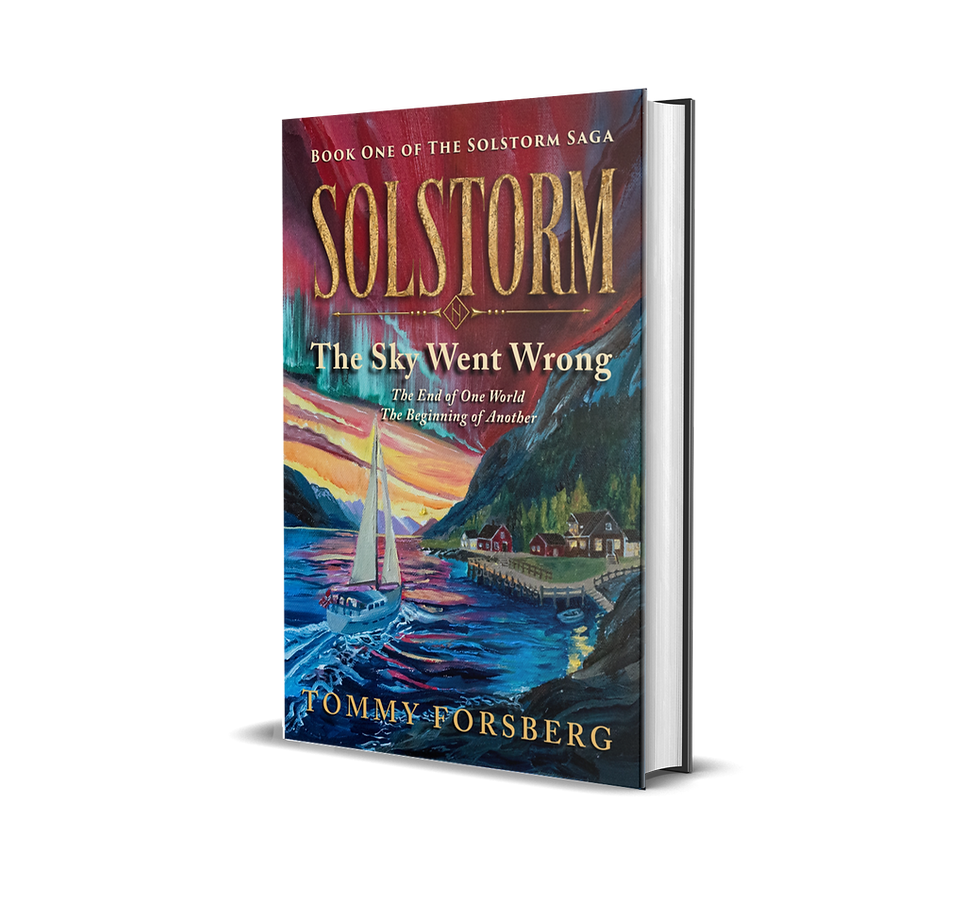
Tommy Forsberg is the author of The Solstorm Saga, a Nordic survival fiction series grounded in solar storm collapse, resilience, and realistic systems failure.