How Fast Would Modern Society Struggle After a Total Grid Collapse?
- Tommy Forsberg
- Mar 12
- 24 min read

Updated: Mar 18
Not all at once, but faster than most people think, because electricity is the hidden layer beneath almost everything else.

Opening
Most people imagine darkness first.
They imagine windows going black, streets losing their glow, entire cities reduced to silhouettes and silence. And yes, that would be part of it. But darkness is the least interesting part of a total grid collapse.
The real danger is not that the lights go out.
It is that electricity sits beneath almost everything else so quietly that most people rarely notice it until it is gone. Water. Fuel. Communications. Payments. Refrigeration. Sanitation. Traffic control. Logistics. Climate control. Medical systems. The grid is not just one system among many. In practical terms, it is the layer modern society built the others on top of. That is why a total grid collapse would not break society all at once. It would strip it, layer by layer.
And even that is only part of the truth.
A grid collapse is not one event. It is several different events wearing the same name.
In summer, the pressure falls first on cooling, refrigeration, water demand, and heat-sensitive medicine. In winter, the threat shifts toward heating, shelter, frozen plumbing, and the sudden brutality of exposure. The grid is our climate control. Without it, we become residents of whatever latitude and season we happen to be standing in. CDC guidance on extreme heat explicitly warns that outages can disrupt cooling, refrigerated medicines, and electrically powered medical devices, which is exactly why the season changes the shape of the crisis so quickly.
At first, most people would still think in the language of inconvenience. An outage. A disruption. A delay. Something to be explained, repaired, and folded back into normal life. That assumption would hold, right up until the invisible supports beneath ordinary life began failing one by one, not dramatically at first, but quietly, in sequence. Backup power. Stored pressure. Fuel reserves. Battery life. Delivery schedules. Network uptime. These are all just other names for time.
And time is what a modern blackout burns first.
The First Hours
At first, a total grid collapse would still look temporary.
That is part of what makes it dangerous.
In the first hours, most people would not think in terms of systems failure. They would think in terms of outage, delay, inconvenience, confusion. They would wait for the message, the alert, the explanation, the small ritual of modern reassurance. The system would surely speak in a moment. It always does.
But this time, the system itself is part of what is failing.
The first things people notice are the obvious ones. Lights go out. Card payments stop working. ATMs go dark. Fuel pumps fail where there is no backup power. Mobile networks overload almost immediately as everyone reaches for the same towers at once. Internet access turns patchy or vanishes altogether. Traffic lights fail. Elevators stop. Electric doors stay shut or hang uselessly open. Trains stall. Shops close early, not because they are empty yet, but because they no longer know how to trade, track, or trust what happens next.
Ready.gov explicitly notes that power outages can disrupt communications, water, transportation, retail businesses, grocery stores, gas stations, ATMs, banks, and other services. (Ready.gov)
This is the era of the wait-and-see.
Collective breath-holding.
Most people would still assume the problem was being handled somewhere else, by someone else, with a larger screen and a steadier voice. In the first hours, the crisis still wears the mask of inconvenience. That mask matters. It delays behavior. It delays decisions. It delays the moment when people begin understanding that the failure is not local, not brief, and not neatly contained.
There is another shock in these first hours, quieter but just as important.
It is the shock of inaccessible wealth.
A great deal of modern wealth is not held in the hand. It exists behind systems, account balances, cloud-based records, terminals, networks, authentication layers, and the quiet confidence that all of it will be there when called upon. During an extended outage, FEMA and Ready.gov both warn that ATMs and card systems may not work, which is why official preparedness guidance still recommends keeping cash on hand. (Ready.gov)
That means the first shock is not poverty. It is inaccessibility.
A person with cash in a pocket may suddenly have more usable buying power than someone whose money exists only behind dead terminals and frozen payment rails. Wealth remains on paper. Access to it can disappear in an afternoon.
And even here, the deeper damage is easy to miss.
We no longer live only in a world of things. We live in a world of signals.
When the signal dies, the things remain, trucks, pumps, heaters, doors, tills, but they stop behaving like a system. They become isolated objects waiting for instructions that never arrive.
That is the true atmosphere of the first hours.
Not chaos, not yet.
Confusion.
A strange, suspended confusion in which the world still looks mostly intact, but has already begun losing its ability to coordinate itself.
The First 24 Hours
By the first full day, the outage would begin shedding its disguise.
The obvious failures would still matter, of course. Card terminals would still be dead in many places. Fuel would still sit in underground tanks that could not easily be pumped. Cellular service would still be patchy, overloaded, or draining toward silence. But the more serious shift would be happening in the systems people do not usually think about until they stop behaving like background.
This is where modern life begins leaning on its buffers.
Backup generators. Stored pressure. Water towers. Gravity-fed systems. Refrigerated stock. Battery reserves. Emergency procedures. Staff endurance. All the quiet margins built into modern infrastructure would still be carrying weight, at least for a while. That matters, because the first day of a large-scale power failure is often not the day systems disappear. It is the day you find out which systems were designed to coast for a few hours, which ones can manage a little longer, and which ones were never meant to operate without a living grid beneath them. EPA guidance for utilities notes that power loss can have serious impacts on both drinking water and wastewater systems, including inoperable pumps, pressure losses, and reduced or stopped treatment. (epa.gov)
This is also where one of the most common misunderstandings begins to matter.
People often imagine that no power means no water, instantly. Sometimes that is true, especially in taller buildings where water depends on electric pumps to reach upper floors. But in many places, the tap may still run for a while. Gravity, storage tanks, water towers, and residual pressure can keep water moving longer than people expect. That can be strangely comforting, and dangerously misleading.
Because the uglier problem may not be the clean water side at all.
It may be wastewater.
Sewage lift stations and pumping systems are often far more vulnerable to power interruptions than the average person realizes. When those systems lose power and lack sufficient backup, the problem is no longer merely reduced convenience. It becomes overflow, backup, and contamination. EPA guidance is explicit that lift stations are vulnerable to outages and that when they lose power without adequate emergency power, untreated sewage can back up into homes and businesses or overflow into the environment. (epa.gov)
That is why the first twenty-four hours matter so much.
Backups do not mean safety. They mean time.
A hospital on generator power is not “fine.” A supermarket with failing refrigeration is not “open for business.” A city still pushing water through some of its network is not secure. These are not signs that the system survived. They are signs that the buffers have not fully burned through yet.
And the season changes how quickly those buffers matter.
In heat, refrigeration and cooling start racing the clock almost immediately. CDC guidance warns that outages during hot weather can disrupt refrigerated medications and electric medical devices, which means the pressure falls hardest first on the people least able to tolerate even brief interruption. In cold weather, the threat shifts. Pipes freeze. Homes lose habitable temperature. Shelter becomes a harder fact than inconvenience. The same outage does not strike the same way in July and in January. (cdc.gov)
By the end of the first day, the public mood would begin to change in a subtler way too.
Not panic, not yet.
But thinning confidence.
People would still be waiting for clarity, yet they would begin to notice something more unsettling than darkness: the strange realization that the system is not failing all at once, but in layers, and that some of the most important layers were the ones they barely knew existed.
48 to 72 Hours
By the second and third day, the crisis begins to change character.
In the first hours, people are still waiting for the system to explain itself. By forty-eight to seventy-two hours, that illusion starts wearing thin. The outage is no longer just something happening around daily life. It is beginning to climb inside it.
This is when buffers start burning down in earnest.
The phone in your hand may still have charge, but that no longer means very much if the network it depends on is overloaded, degraded, or running out of backup resilience. FEMA’s power outage planning documents warn that communications systems with backup batteries can still fail during extended loss of electricity. The device may survive longer than the signal.
The same is true of food.
At first, a refrigerator is simply a closed box holding on to the last of the cold. But time turns that into a countdown. CDC and FDA guidance are very clear on this point: refrigerated perishable food becomes unsafe surprisingly quickly once power is lost, especially if doors are opened, while freezer time depends heavily on how full the freezer is and how often it is disturbed.
This is where a modern outage starts becoming intimate.
The ice softens. The batteries thin out. The last strong bars of signal fade. The grocery shelves that looked merely strained on the first day begin looking picked over, then static, then oddly final. Trucks have not stopped existing. Warehouses have not vanished. But the pulse that keeps modern distribution moving, software, power, fuel, routing, payments, communications, has begun to stutter. A just-in-time system is efficient right up until time itself becomes uncertain.
There is a quieter countdown running too.
Medicine.
By the first several days, a medical emergency begins unfolding behind closed doors, in fridges, coolers, nursing routines, pharmacy back rooms, and households already living close to the edge of interruption. CDC and FDA guidance both note the importance of refrigeration for certain medicines, including insulin and many liquid drugs, and warn that outages can quickly complicate safe storage and replacement.
That means the crisis is no longer only about food and fuel. It is also about the invisible cold chain that keeps some people alive.
And then there is the part most people underestimate until they are inside it.
The information vacuum.
A modern person does not merely use information. He lives inside a steady drizzle of explanation. Alerts, messages, maps, forecasts, headlines, group chats, official statements, background reassurance, constant low-level narrative. When that flow thins out, the loss is not only practical. It is psychological.
Silence changes people.
When reliable information stops arriving, the mind does not sit quietly and wait. It begins filling the gaps itself. Rumor moves in. Guesswork hardens into conviction. Fear begins trying on the clothes of certainty. CDC’s crisis communication guidance exists for a reason: in emergencies, clear and credible information is part of response, not a decorative extra. When information fails, confusion does not remain passive for long.
This is the real shift by the third day.
The problem is no longer just material. It is cognitive.
People stop asking only, “What still works?”
They begin asking, “What is actually happening?”
And if the system cannot answer clearly, they will begin answering for themselves.
That is when a blackout stops feeling like an outage and starts feeling like an event.
The First Week
By the end of the first week, the outage has usually shed the last of its harmless language.
It is no longer a disruption. No longer a delay. No longer the sort of inconvenience people can narrate themselves through with a charged phone, thawing freezer, and the phrase surely tomorrow.
By now, the question is no longer when the lights return.
It is what still functions without them.
This is the point at which a power failure becomes structural.
Sanitation begins moving to the front of the crisis. Not because it is dramatic, but because it is relentless. Water may still be available in some places through storage, gravity, pressure, or emergency measures. But wastewater is less patient. When lift stations lose power, when backup fuel runs thin, when pumping becomes intermittent or stops altogether, the problem changes from inconvenience to overflow, backup, and contamination. EPA guidance is explicit that lift stations are vulnerable to power outages and flooding, and that inadequate emergency power can lead to untreated sewage backing up into homes and businesses or overflowing into the environment. (epa.gov)
This is why sanitation can become more dangerous than empty taps.
People think first of thirst. They should think equally of waste.
And if heavy rain arrives during that first week, the sanitation problem changes shape again. It is no longer only what backs up indoors. In many places, stormwater and low-lying drainage depend on pumps too. EPA and CDC both warn that flooding and overloaded wastewater systems can push untreated sewage into streets, buildings, and the wider environment, creating a health hazard that is part water event, part infrastructure failure, part public health problem. (epa.gov) (cdc.gov)
That is when streets stop behaving like infrastructure and start behaving like basins.
Fuel becomes decisive too.
In the early days, backup generators create the illusion that critical systems are holding. Hospitals still function. Water utilities still push what they can. Some communications sites keep talking. But backup power is only as resilient as the fuel chain behind it. FEMA’s power outage planning documents and EPA emergency planning material both emphasize fuel as a critical dependency for continued generator operations at essential facilities, including water and wastewater assets. (fema.gov) (epa.gov)
By the first week, the crisis is no longer just about having fuel somewhere.
It is about whether that fuel can be prioritized, transported, protected, and delivered to the systems that matter most before something else fails first.
Medicine and healthcare begin narrowing too.
The cold chain does not vanish in one dramatic moment. It frays. Refrigerated medications, insulin, biologics, temperature-sensitive supplies, and routine pharmacy operations all become harder to sustain when power, communications, transport, and local storage are unreliable. CDC and FDA guidance on outages and emergency storage make clear that temperature-sensitive medicines require planning precisely because power loss can quickly complicate safe storage and replacement. (cdc.gov) (fda.gov)
By this stage, the crisis is no longer evenly distributed.
That is the deeper shift of the first week.
A healthy person with stored food, usable water, cash, and a tolerable climate may still feel strained, but manageable. Someone dependent on dialysis, refrigerated medicine, medical oxygen, powered mobility, sewage integrity, or regular home care is living in another event entirely.
And that is true at the level of neighborhoods as well.
By the end of the first week, places begin diverging sharply. Communities with gravity-fed water, stored fuel, competent local leadership, practical redundancy, and strong trust begin looking very different from places built on thin margins, fragile logistics, and the assumption that the larger system will always return in time. FEMA’s long-duration power-outage planning materials explicitly frame such events as requiring prioritization of scarce resources across lifelines, which is another way of saying the crisis is no longer purely technical. It has become social, administrative, and moral. (fema.gov)
This is the point where an outage stops being measured only in hours and starts being measured in trust.
In patience.
In competence.
In whether people still believe the systems above them know what they are doing, and whether they still believe the people beside them do.
Beyond the First Week
Beyond the first week, the crisis stops being defined by the outage itself and starts being defined by divergence.
Up to this point, much of the story has been about shared disruption. Dark screens. Failing payments. Weakening signals. Thinning buffers. But after a week or more, the experience stops being universal. Two neighborhoods in the same city can begin living in very different versions of the same event. One may still have usable water, a functioning clinic, disciplined local leadership, and people who know one another well enough to share information without immediately poisoning it. Another may be living in a slower, dirtier, more frightened reality shaped by scarcity, rumor, unmanaged waste, and the growing sense that the larger system is no longer returning in time.
That is what a prolonged grid collapse really reveals.
Not just fragility, but unevenness.
At this stage, outcomes depend less on the grid as an abstract machine and more on what existed beneath ordinary life before the lights ever went out. Fuel reserves. Gravity-fed or pressure-supported water. Wastewater containment. Medical prioritization. Local competence. Redundancy. Trust. FEMA’s lifelines framework is useful here because it treats a long-duration outage not as a single technical failure but as a crisis across food, water, shelter, health, energy, communications, transportation, and public safety, each one leaning on the others.
That interdependence matters more with every passing day.
Fuel is no longer just fuel for cars. It is power for generators, pumps, clinics, wastewater stations, communications sites, delivery fleets, and emergency response. Water is no longer just water from the tap. It is pressure, treatment, storage, sewage handling, hygiene, and the difference between a difficult week and a public-health emergency. Communication is no longer convenience. It is the ability to coordinate scarce resources, calm rumor, direct medical need, and keep one frightened pocket of society from misreading another. CISA’s resilience planning and access frameworks make the same point in bureaucratic language: critical infrastructure sectors are interdependent, and prolonged failure in one lifeline quickly affects the others.
This is also where weather and season stop being background and become active forces.
A prolonged outage during high heat is one kind of event. A prolonged outage during deep cold is another. In heat, water demand, refrigeration, cooling, and medicine storage become ruthless clocks. In freezing conditions, the crisis hardens around shelter, heating, burst plumbing, and exposure. The outage is the same only on paper. In human terms, season rewrites the shape of the emergency. CDC guidance on extreme heat and outages is blunt about the dangers to cooling, medical devices, and refrigerated medication during hot-weather power failure.
By now, healthcare has narrowed too.
Not collapsed everywhere, not vanished into fantasy, but narrowed. Choices have become harsher. Systems designed for normal pressure are now doing triage in slow motion. People dependent on electricity, refrigerated medicine, assisted mobility, routine home care, or stable clinical access are living in a different event from the healthy and the lucky. Public-health planning literature repeatedly treats vulnerable populations as requiring focused attention during extended emergencies because the burden does not fall evenly.
And then there is trust.
Trust becomes a currency more important than comfort.
Not sentimental trust. Practical trust. Trust that the water advice is true. Trust that the fuel is going where it should. Trust that the clinic still knows what it is doing. Trust that the person giving directions is informed rather than merely loud. Trust that your neighbors are frightened in the same direction you are, not in a way that turns them into a separate threat.
This is where the event becomes social in the deepest sense. Not because society vanishes, but because society is what remains when systems thin out.
CISA’s resilient power guidance and FEMA’s preparedness frameworks both make a version of this point: critical facilities and communities do not endure long outages by magic, but by planning, prioritization, coordination, and human competence.
That is why long outages do not make every community the same.
They reveal which ones were sturdy, which ones were brittle, and which ones only looked modern because the current was still flowing.
A Fast Breakdown of What Fails, and What It Feels Like
0-12 Hours - The Wait-and-See
System status:
Digital disruption arrives first. Card payments fail. ATMs go dark. Fuel pumps stop where backup power is absent. Cellular networks overload as everyone reaches for the same towers at once. The device in your hand may still have charge, but the network it depends on is already beginning to thin.
Human impact:
Collective breath-holding. Most people still assume the system will explain itself shortly. They wait for the message, the alert, the official voice, the small reassuring sign that someone, somewhere, still has a larger screen and a calmer answer.
24-48 Hours - Buffer Burn
System status:
The visible outage gives way to invisible countdowns. Some water still runs through storage, gravity, pressure, or emergency support. Refrigeration weakens. Supply chains begin to stutter. Wastewater vulnerabilities emerge where lift stations depend on uninterrupted power. Backup systems are still carrying weight, but less gracefully now.
Human impact:
Borrowed time starts running out. The ice softens, batteries thin out, and reassurance drains away with the last strong bars of signal. People begin noticing that the system has not stopped all at once. It is wearing down in layers.
72+ Hours - The Narrative Shift
System status:
Generator fuel becomes decisive. Communications thin further. Sanitation risks grow. Wastewater failures become harder to contain. Medicine cold-chain problems begin turning private vulnerability into public crisis. The outage is no longer just electrical. It is logistical, medical, and psychological.
Human impact:
People stop waiting for the system to speak clearly. They begin reading one another instead. Who looks calm. Who looks frightened. Who looks prepared. Who looks desperate. The public story fragments.
People stop looking at their screens and start looking at their neighbors’ hands.
Why People Misjudge This
Most people do not misunderstand grid collapse because they are foolish.
They misunderstand it because modern life hides its dependencies too well.
Electricity is easy to mistake for comfort. A light switch. A warm room. A charged phone. A convenience so ordinary it barely deserves thought. But electricity is not only comfort. It is structure. It is the hidden layer beneath water pressure, fuel distribution, payment systems, refrigeration, communication, sanitation, traffic control, medical storage, and much of the coordination that makes modern society feel stable.
That is the first mistake.
People think the grid means light. In reality, it means continuity.
The second mistake is money.
Most people assume that if they have money, they have access. In ordinary times, that is close enough to true that the distinction barely matters. In a prolonged outage, the distinction becomes sharp. Money can remain in an account while access to it disappears behind dead terminals, frozen networks, silent ATMs, and payment systems that can no longer speak to each other. The problem is not immediate poverty. It is the collapse of the pathways that turn stored wealth into usable action.
The third mistake is water.
People tend to imagine a clean binary. Either the water works or it does not. Real systems are uglier than that. Water may continue for a while through storage, gravity, pressure, or backup support. Wastewater may fail faster. A tap that still runs can create a false sense of safety while sewage systems are already edging toward backup, overflow, and contamination. What looks functional from the kitchen sink may be far less stable under the street.
The fourth mistake is the network.
We have grown so accustomed to carrying information in our pockets that many people no longer distinguish between the device and the system behind it. A phone with a full battery feels like capability. But a charged phone without functioning towers, data links, or resilient communications is mostly a polished piece of glass with a memory. The network is the thing. The device is only the window.
And then there is the deepest mistake of all.
People prepare for spectacle and ignore dependency.
They imagine collapse as noise, fire, and visible panic. Something cinematic. Something obvious. In reality, much of it begins as subtraction. Signals thinning out. Margins shrinking. Deliveries not arriving. Freezers warming. Pumps quieting. Sanitation becoming uncertain. Information hardening into rumor. A crisis does not need to look dramatic at first to become dangerous. In fact, one of the reasons it becomes dangerous is that it often looks survivable right up to the point where the buffers burn through.
We no longer live only in a world of things. We live in a world of signals.
When the signal dies, the things remain. Trucks. Pumps. Heaters. Doors. Generators. Shelves. Towers. They do not vanish. They simply stop behaving like a system.
And that is the part most people are least prepared to recognize.
What Holds Longer Than People Think
If all of this sounds bleak, it should.
But that is not the same as saying everything fails at once, or that people become useless the moment the current disappears.
One of the most persistent mistakes in disaster thinking is to imagine that fragility is the whole story.
It is not.
Modern systems are more brittle than many people realize, but they are also full of people who know how to keep difficult things running longer than outsiders would expect. Utility crews. Water operators. Hospital staff. Municipal engineers. Fuel coordinators. Maintenance workers. Emergency planners. People whose names are rarely known outside their own departments, but whose competence becomes load-bearing the moment the ordinary system begins to thin.
That matters.
A city does not remain habitable because the grid is healthy. It remains habitable because human beings keep building workarounds, triaging failures, prioritizing what matters most, and buying time where there should not have been any left.
Some systems also hold longer than people assume.
Gravity-fed water does not care much about app notifications or public panic. Stored fuel, if it is protected and properly managed, can keep key services alive longer than rumor would suggest. Buildings with sensible redundancy hold out better than those built on thin margins and optimistic assumptions. Communities with practical local knowledge, the kind that knows where the manual overrides are, who has a generator, who understands the pumps, which nurse lives nearby, which farmer has a tractor, can remain functional long after more polished places begin coming apart at the edges.
Preparedness, in other words, is not just storage.
It is competence.
And beyond competence, it is relationship.
True preparedness is not only what you stored. It is who you know before the elevators stop moving.
Because when systems thin out, the question becomes less “What exists?” and more “Who can still make use of it?” A generator with no fuel is an expensive shape. Fuel with no way to distribute it is a promise. Stored medicine without someone who knows how to prioritize it is only a narrowing clock. Infrastructure matters, but human coordination is what keeps infrastructure from becoming scenery.
This is where trust begins to matter in a practical, unsentimental way.
Not abstract trust. Not slogans. Useful trust.
Trust that the person giving instructions understands the system better than the crowd does. Trust that the water advice is real. Trust that the fuel is going where it must go first. Trust that neighbors will warn before they take. Trust that people are still capable of acting like a society even when the systems that usually organize society have begun to fail.
History, emergency planning, and real-world outages all suggest that people are often better at helping each other in the early stages of crisis than the darker fantasies of modern culture would have us believe.
The problem is not that cooperation is impossible. The problem is that cooperation, like backup power, is also a buffer. It lasts longer in places where competence, trust, and local connection already existed before the event.
That is the difference between resilience and appearance.
A community that can still communicate face to face, improvise, share labor, protect sanitation, care for the medically vulnerable, and make calm decisions under pressure is not unaffected by collapse. But it is not helpless either.
And that may be the most important correction in this whole discussion.
A total grid collapse would expose weakness, certainly. It would expose dependence, illusion, and the fragility of systems most people mistake for permanence. But it would also reveal something else, quieter and much easier to overlook: the stubborn capacity of capable people to keep parts of the world working even after the seamless version of it has failed.
That capacity is not magic.
It is skill, memory, planning, improvisation, and the fact that not everything worth relying on runs on electricity.
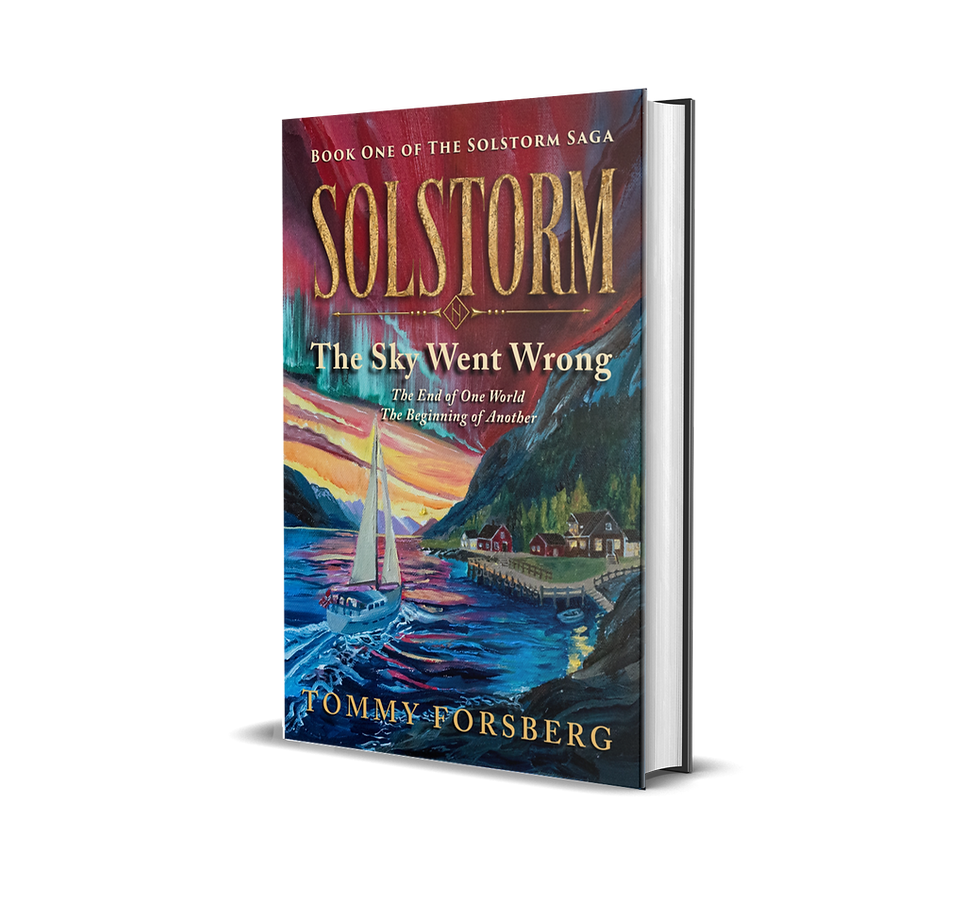
Why This Matters in Solstorm
This is the part that interests me most.
Not the darkness itself.
Not the spectacle of collapse.
Not the easy drama of systems failing all at once in some single cinematic blow.
What interests me is the sequence.
First power.
Then communication.
Then payment.
Then fuel.
Then refrigeration.
Then wastewater.
Then medicine.
Then trust.
Then the slow and very human question of what remains when convenience is stripped away and the hidden machinery of ordinary life stops carrying people for free.
Not in fantasy.
Not in indulgent ruin.
But in the moment when certainty begins to thin out and people are forced back onto older things, skill, judgment, preparation, memory, physical work, local knowledge, seamanship, cooperation, and the difficult business of deciding what kind of people they will be when the systems around them no longer make the easy choices for them.
A severe solar storm is compelling in fiction for exactly that reason.
It does not feel like an enemy in the usual sense. It has no ideology. No face. No speech. No negotiation. It does not invade. It interferes. It reaches into the invisible scaffolding of modern life, satellites, grids, navigation, timing, communication, forecasting, and begins loosening the bolts one by one. The result is not instant apocalypse.
The result is exposure.
Exposure of weakness.
Exposure of dependency.
Exposure of illusion.
But also exposure of resilience, competence, and character.
That is where the real story begins.
Because once the systems start failing in sequence, survival is no longer abstract. It becomes practical.
Who knows how to move without a screen. Who understands weather instead of just receiving it. Who can store water, protect sanitation, ration fuel, keep calm, read a chart, mend a machine, preserve food, or hold a community together when rumor begins competing with reality.
Those are older questions than electricity.
And they are far more interesting to me than destruction for its own sake.
That is why a story like Solstorm is not really about the end of the world.
It is about the end of assumptions.
The end of the assumption that payment is the same as wealth.
The end of the assumption that having a device is the same as having communication.
The end of the assumption that the tap, the pump, the pharmacy, the clinic, the forecast, the signal, and the shelf will simply continue behaving because they always have before.
And in the space left behind by those assumptions, other things return.
Not romance.
Not simplicity.
Certainly not comfort.
But reality.
Reality in the form of labor, cold, distance, responsibility, fear, improvisation, trust, and the sudden weight of practical knowledge. Reality in the form of boats mattering again. Harbors mattering again. Firewood, fuel, rope, salt, tools, seed, engines, charts, hands, backs, and strong nerves mattering again. Reality in the form of people rediscovering that survival is rarely a single heroic act. More often it is competence, repeated daily, under pressure, without applause.
That is the world I find worth writing about.
Not because collapse is beautiful.
But because what people do next reveals who they really are.
Closing
Most people think first of darkness.
That makes sense. Darkness is immediate. Visible. Primitive in a way modern people still understand instinctively.
But darkness is only the surface.
The deeper truth is that electricity became the quiet foundation beneath modern life, so quiet that most people stopped seeing it at all. It moved into the walls, under the streets, behind the pumps, inside the towers, beneath the payments, beneath the cold chain, beneath the signal, beneath the ordinary rhythm of a world that began to feel permanent simply because it had worked for so long.
A total grid collapse would not erase society in a single theatrical stroke.
It would expose what was load-bearing all along:
Water.
Fuel.
Sanitation.
Communication.
Medicine.
Competence.
Trust.
That is what makes it so unsettling, and so interesting.
Not that the system can fail.
But that so much of modern confidence rests on systems most people never think about until they begin to thin out and disappear.
The first thing a grid collapse takes is power.
The next thing it takes is the illusion that modern life was ever as solid as it looked.
FAQ - Grid Collapse, Water, Phones, Cash, and Survival
If the power goes out, will my water stop immediately?
Not always. In many places, water can keep flowing for a while because of storage tanks, gravity, or residual pressure in the system. The more immediate danger may be wastewater. If sewage lift stations lose power and backup fails, the problem can shift quickly from inconvenience to backup, overflow, and contamination. EPA notes that pump failure can lead to sewage backup into homes and businesses, and FEMA notes that power loss can reduce pressure and affect water service. (US EPA)
Can I still use my phone if I have a backup battery or solar charger?
Your phone may still have power, but that does not guarantee a working network. During an extended outage, cellular systems can overload or lose resilience as backup batteries and fuel-dependent systems run down. FEMA explicitly warns that communications backup battery-powered systems can fail during extended loss of electricity. (FEMA)
Is total social chaos inevitable in the first week?
No. Early disaster behavior is often more cooperative than popular culture suggests. The bigger risk is not instant madness, but thinning information, rising strain, and eroding trust if people no longer know what is true, what is available, or when help is coming. In prolonged outages, the social contract is stressed by uncertainty as much as by scarcity. This is a reason emergency planning places so much emphasis on clear communication and coordination. (FEMA)
How much cash should I actually keep on hand?
Enough in small bills to handle basic purchases when cards, ATMs, and payment terminals are not working. Ready.gov specifically advises keeping extra cash because ATMs and credit card machines may not work during an extended power outage. Small denominations matter more than large ones when change is limited and systems are down. (ready.gov)
Why is just-in-time logistics such a big deal?
Because modern stores are not deep local warehouses. They are fed by constant coordination, power, fuel, transport, refrigeration, payments, and timing. When the grid fails, the shelves do not empty because food vanishes from the world. They empty because the systems that keep goods moving stop behaving like a system. FEMA’s CERT training materials note that fuel flow can be interrupted and that ATMs and credit card systems can become inoperable during disasters, which shows how quickly logistics and distribution begin to seize up. (ready.gov)
Will my car still work after a solar-induced grid collapse?
Possibly, but the bigger immediate problem for most people is fuel access, not the vehicle itself. Even if a car remains operable, modern gas stations usually require electricity to pump fuel. In a long outage, a working car with no way to refill becomes a short-lived advantage. Ready.gov explicitly lists gas stations among the services disrupted by power outages. (ready.gov)
What is the single most overlooked part of preparedness?
Sanitation. People often focus on food, light, and fuel first, but wastewater and refuse become dangerous quickly when systems fail. Sewage backups, overflows, and contaminated floodwater can create public-health problems long before hunger becomes the dominant threat. EPA warns that sanitary sewer overflows can back up into homes and threaten public health. (US EPA)
Sources
Ready.gov, Power Outages - U.S. preparedness guidance on how outages affect communications, water, transportation, retail, ATMs, banks, and fuel access.
Ready.gov, Preparedness Resolution Guidance - Includes practical advice on keeping cash because ATMs and card systems may not work during extended outages.
FEMA, Power Outage Incident Annex - Federal planning document on long-duration outage impacts across lifelines, including communications, fuel, and critical services.
U.S. EPA, Power Resilience Guide for Water and Wastewater Utilities - Explains how power loss affects pumps, water pressure, treatment, and wastewater operations.
U.S. EPA, Flood Resilience: A Basic Guide for Water and Wastewater Utilities - Useful for the article’s sanitation, lift station, overflow, and stormwater logic.
U.S. EPA, Sanitary Sewer Overflows (SSOs) - Background on sewage overflows, public health risks, and why wastewater becomes a major issue during infrastructure failure.
CDC, About Heat and Your Health - Supports the article’s seasonality point, especially how outages become more dangerous during heat events.
CDC, Keep Food Safe After a Disaster or Emergency - Source for refrigerated food spoilage and freezer timing during outages.
CDC, What to Do to Protect Yourself During a Power Outage - Covers refrigerated medications, medical devices, and household guidance during extended loss of electricity.
FDA, Insulin Storage in an Emergency - Supports the medicine cold-chain discussion, especially around insulin and temperature-sensitive storage.
CDC, Crisis and Emergency Risk Communication Manual - Supports the article’s information-vacuum and rumor dynamics, especially the role of clear communication in emergencies.
CISA, Infrastructure Resilience Planning Framework - Useful for the article’s broader systems view, especially how lifelines and critical infrastructure depend on one another.
CISA, Resilient Power Best Practices for Critical Facilities and Sites - Supports the sections on backup power, prioritization, and how key sites endure longer outages.