How Long Would Food Last After a Major Collapse? The Supply Chain Nobody Thinks About
- Tommy Forsberg
- Mar 15
- 11 min read

Updated: Mar 19
It would begin with the supermarket.
Not with empty shelves, not yet. With full ones.
Walk into any large supermarket on an ordinary Tuesday and the abundance looks almost absurd. Towers of canned goods. Walls of refrigerated meat. Bread stacked in rows. Produce misted and gleaming under fluorescent light.
It looks like a pantry. It is not a pantry.
It is the visible end of a chain that runs from farms, factories, ports, and distribution centres through hundreds of interdependent logistics systems, all of which depend on power, fuel, digital coordination, and the quiet assumption that tomorrow's delivery will arrive on time.
When that assumption breaks, the shelves do not stay full for long.
Understanding why, and how fast, reveals what modern civilisation really runs on.
The Supermarket Illusion
Most people, if asked how much food is in a large supermarket, would guess weeks.
Estimates vary depending on store size, location, and product mix, but retail analysts and emergency planners consistently describe supermarket inventory in terms of days rather than weeks under normal consumption rates. Under panic buying, that window compresses dramatically, sometimes to hours for high-demand categories.
Modern retail does not operate on deep reserves. It operates on replenishment. Stock arrives, stock moves, new stock arrives. The system is efficient precisely because it carries as little inventory as possible at any given moment. Warehouse space costs money. Spoilage costs money. Capital tied up in sitting inventory costs money. The entire architecture of modern food retail is designed to keep the pipeline moving, not to build a buffer.
That pipeline is thinner than it looks.
When a crisis hits, any crisis, at any scale, the first thing that happens is not the shelves emptying. It is the shopping behaviour changing. People who would normally buy three days of food buy three weeks of food instead. The demand spike is immediate. The replenishment system, designed for normal consumption rates, cannot respond in time.
What happened with basic staples during the early weeks of the 2020 pandemic was a demonstration at small scale of the same psychology. Shelves that looked permanently stocked were stripped in hours, not because there was a food shortage, but because the rate of removal suddenly exceeded the rate of replacement. The system was not broken. It was simply overwhelmed by a change in behaviour it was never designed to absorb.
In a full grid collapse, the behaviour change is the same. The difference is that the replenishment system cannot recover, because the failure is not temporary.
The shelves empty. The trucks stop coming. And what was never a pantry reveals itself as exactly what it always was, the last visible moment of a supply chain that no longer exists.
The Delivery Chain Behind the Shelf
To understand why replenishment stops, it helps to work backward from the supermarket through the systems that feed it.
Behind every stocked shelf is a regional distribution centre, a large automated warehouse that aggregates stock from multiple suppliers and pushes it out to stores on tight schedules. Distribution centres are designed for throughput, not storage. The buffer they carry varies by facility and product type, but the principle is the same. Stock moves through, it does not accumulate. When the inbound supply stops and outbound deliveries cease, what remains is not a deep reserve. It is whatever happened to be on the floor when the system stopped.
Behind the distribution centre are the processing facilities, the plants where raw agricultural products become packaged goods. These operations are power-intensive, water-intensive, and entirely dependent on staffing and supply inputs arriving on schedule. A grid failure does not just turn off the lights in a processing plant. It stops the production line, disables the refrigeration that keeps raw inputs viable, and triggers safety shutdowns that require specialist restart procedures. Getting a large food processing facility back online after an unplanned shutdown is measured in days under the best conditions, and the best conditions do not exist in a grid collapse.
Behind the processing facilities are the transport networks. This is where the failure becomes visible at scale. Trucks need fuel. Fuel pumps need electricity. In a grid collapse, the fuel supply chain fails in parallel with the food supply chain. Drivers cannot fill tanks, depots cannot dispense, and the digital dispatch systems that coordinate routing and delivery go silent. Loads already in transit become stranded. Drivers face the same problems as everyone else, no communications, no way to confirm whether the destination they are heading toward still has functioning receiving infrastructure.
For countries that import a significant share of their food, the port dimension adds another layer of fragility. That food moves through facilities which depend on power, crane systems, refrigerated container handling, and digital customs and logistics infrastructure. When port operations fail, the import pipeline closes. The timeline from port disruption to shelf impact is not measured in weeks. It is measured in days.
The supply chain is only as strong as its most fragile link. In a grid collapse, almost every link fails at once.
Remote Communities, A Different Crisis
Everything described above applies to well-connected urban areas and towns. For remote communities, and across the far north, whether in Arctic Norway, northern Canada, coastal Alaska, or any other isolated northern region, remote is not a marginal case but a defining feature of how a significant part of the population actually lives, the situation is structurally different, and in important ways worse before it becomes better.
The supply chains serving remote northern communities are already longer and thinner under normal conditions. A village accessible only by ferry, or connected to the nearest town by a single road through mountain or coastal terrain, does not receive daily deliveries. It may receive them once or twice a week. The local store is not a node in a dense logistics network. It is the end of a long, exposed line.
That means the baseline buffer is lower. The store serving a small remote community may carry only a limited buffer of normal consumption, and under panic buying that compresses to a day or two just as it does everywhere else, except there is no second store down the road and no prospect of a delivery arriving to restock.
The road itself becomes a problem. Many remote northern communities depend on infrastructure that is already vulnerable under normal winter conditions. A grid collapse that disables fuel supply and disrupts the maintenance coordination that keeps mountain roads and ferry routes operational does not just slow the delivery chain. It severs it.
Ferries present the same problem with additional complexity. A ferry is a fuel-dependent, electronically coordinated vessel operating on a schedule maintained by systems that no longer function. When it stops running, the community it serves becomes, in practical terms, an island in a deeper sense than geography alone.
And yet.
The same isolation that makes the supply problem acute is the isolation that historically produced the knowledge and infrastructure to survive without supply chains. Remote northern communities did not always depend on weekly deliveries from distribution centres.
The skills that kept people alive before that system existed, fishing, hunting, preserving, maintaining food stores through winter, knowing the land and sea well enough to extract sustenance from both, did not disappear everywhere. In many places they persisted because they were never entirely optional.
A small coastal community with active fishing infrastructure, functional boats, and people who still know how to salt and dry fish is in a fundamentally different position than an urban neighbourhood with empty shelves and no alternative.
The crisis arrives faster in remote communities. But the recovery, for those with the right knowledge and infrastructure, can also begin sooner.
The Refrigeration Problem
Once the delivery chain stops, attention turns to what is already on the shelves and in the storage rooms behind them. And here the picture becomes significantly darker, faster than most people expect.
Somewhere between thirty and forty percent of the modern food supply requires continuous refrigeration to remain safe. Meat, fish, dairy, fresh produce, certain ready-made foods, much of it depends on an unbroken cold chain from production through storage through retail to the consumer. That chain is maintained by electricity.
Without power, the temperature in a domestic refrigerator begins rising within hours. Food safety guidelines suggest that perishable items should be considered unsafe after approximately four hours if the door has been opened regularly, longer if kept firmly closed. In a chest freezer, the window extends to one to two days, sometimes longer depending on how full it was and the ambient temperature.
Commercial refrigeration units vary widely in design and thermal retention. Some large cold rooms hold temperature reasonably well through short outages. Others, particularly open display cases common in supermarket meat and dairy sections, are not designed for temperature retention at all. They are designed for continuous cooling. The result is uneven, but the direction is the same everywhere. Without power, the cold chain fails.
What this means in practice is that a significant portion of the visible food supply becomes a health hazard within the first few days of a grid collapse, not a resource, but a source of contamination risk that compounds an already difficult situation.
There is a partial natural exception that is specific to cold northern climates. In a northern winter, ambient outdoor temperatures across much of the far north are cold enough to function as natural refrigeration. Food that would spoil rapidly in a temperate climate can be safely stored for much longer when the outdoors is functioning as a giant freezer. This is not a complete solution. It does not help in summer, it requires secure outdoor storage, and it does not address all food categories equally. But it is a genuine and historically grounded advantage that northern communities possess.
Traditional northern food preservation was, in part, a sophisticated exploitation of exactly this advantage. Knowing how to use cold, wind, salt, and smoke to extend the viability of food through long winters is not folk craft. It is applied physics that kept entire cultures alive.
What Actually Lasts, The Long Tail
Beyond the perishable supply and the immediate crisis of empty shelves, a different food landscape emerges, one defined not by abundance but by what was stored, what was preserved, and what can be produced.
Canned goods represent the most accessible long-tail resource. Properly stored, many canned foods remain safe for two to five years or more. But several factors limit their role in a collapse scenario. Panic buying strips them from shelves faster than almost any other category. Distribution is uneven, households that prepared have them, households that did not are without. And canned goods represent calories and basic nutrition, not a complete diet. They are a bridge, not a foundation.
Dried staples, grains, legumes, rice, flour, dried pulses, are the genuine long-tail food supply. Calorie-dense, stable at room temperature, and viable for years if stored correctly, they represent the deepest reserve in any functional food system. The challenge is that they require cooking fuel, clean water, and knowledge to use effectively. A bag of dried lentils is not food until someone knows what to do with it and has the means to do it.
Traditional preservation methods, salting, smoking, drying, fermenting, are where northern knowledge becomes practical survival infrastructure rather than heritage interest. These techniques do not require electricity. They require skill, the right raw materials, and time.
Communities and individuals who maintained these practices possess a form of food security that no supply chain disruption can reach.
Fishing and hunting deserve honest assessment rather than romantic treatment. Coastal and northern communities with genuine fishing infrastructure, boats, knowledge, equipment, have access to a real food resource. The critical caveat is that everyone will be competing for the same resource simultaneously. Fishing grounds that sustainably support a community under normal conditions will face immediate pressure when they become the primary food source for a much larger and more desperate population. Management, cooperation, and restraint become survival questions almost immediately.
Foraging is real but marginal. It supplements. It does not sustain. The gap between what the land can provide through foraging and what a community needs in calories is large, and it widens as the season changes.
Seeds, The Most Undervalued Resource
Somewhere in the first weeks of a collapse, the calculus of value shifts in ways that surprise almost everyone who has not thought carefully about it in advance.
Gold becomes difficult to eat.
Fuel becomes currency. But seeds, the capacity to produce food rather than consume existing stores, quietly become one of the most strategically important resources in existence.
The distinction between consuming and producing is the difference between a timeline measured in weeks and one measured in seasons. Stockpiles deplete. A productive food system, however small and however hard-won, does not.
This is not a simple advantage. Having seeds without knowing how to use them is nearly worthless. Growing food at northern latitudes requires knowledge of what actually thrives in short growing seasons, how to protect crops from late frosts, and how to save seed from one year to the next rather than depending on hybrid varieties that do not breed true.
Heritage varieties adapted to northern conditions represent accumulated agricultural knowledge that took generations to develop and can be lost in a single generation of disuse.
A community that holds both the seeds and the knowledge of how to use them holds something no delivery chain can replicate and no collapse can take away.
When Rumour Moves Faster Than Replenishment
The food does not simply run out. It disappears in a social sequence that is highly predictable, widely ignored, and in many ways more dangerous than the physical scarcity itself.
Panic buying begins before most people understand the severity of what is happening. It is driven not by rational assessment of supply but by social contagion, the sight of others buying more triggers the same behaviour in observers, which empties the shelves before the actual shortage has arrived. The shortage becomes self-fulfilling.
Hoarding concentrates resources in ways that accelerate scarcity for everyone else. The household that stockpiles a month of canned goods removes those goods from the available supply for everyone who arrives later. Under normal conditions this is individually rational. Under collapse conditions it is individually rational and collectively catastrophic.
Food rapidly becomes a power resource. Who controls it, who distributes it, and on what terms becomes a political question within days.
The person or group that controls access to calories controls, to a significant degree, the behaviour of everyone who needs them.
The social character of a community, whether it trends toward sharing or hoarding, toward trust or suspicion, toward collective management or individual accumulation, becomes a survival variable almost immediately. Communities that established trust networks, shared resource agreements, and collective decision-making before the collapse are measurably better positioned than those that did not.
The difference between resilience and collapse is not only about what is stored. It is about what was built between people before the crisis arrived.
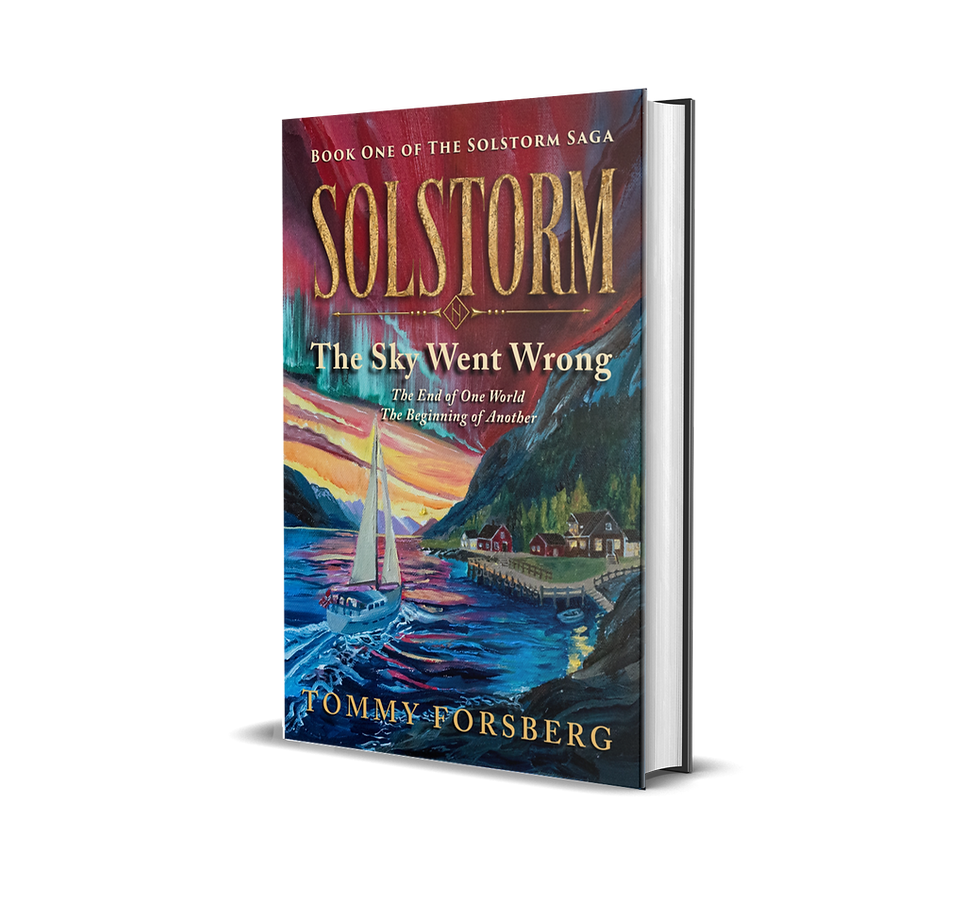
Why This Matters to Solstorm
Skjoldheim was not built on sentiment.
The off-grid food systems, the preserved stores, the fishing infrastructure, the seed knowledge, the trust networks, none of it was romantic. It was a clear-eyed response to a supply chain that Bjørn and Sakari understood, perhaps better than most, was always thinner than it appeared.
When the delivery routes go silent and the cold chain begins to fail, the question that determines everything is simple: did you build something that works without the systems that just failed?
In the world of Solstorm, that question has already been answered.
Common Questions About Food Supply and Collapse
How long would supermarket food last after a grid collapse?
Under panic buying conditions, high-demand items can be gone within hours. Overall supermarket stock is consistently described by emergency planners in terms of days rather than weeks under normal consumption. Replenishment stops when the delivery chain fails.
Why are remote communities especially vulnerable?
Because their supply chains are already longer and thinner under normal conditions. A community receiving deliveries once or twice a week starts with a lower buffer and has no nearby alternative when deliveries stop. The road or ferry route that connects them is itself vulnerable to the same failures.
How quickly does refrigerated food become unsafe?
Food safety guidelines suggest perishables in a domestic refrigerator should be considered unsafe after approximately four hours of regular use without power. Commercial refrigeration varies, but open display cases offer little thermal retention. The direction is the same everywhere, without power, the cold chain fails within days.
Does a cold climate help?
Yes, meaningfully so in winter. Ambient temperatures across the far north can function as natural refrigeration, extending the safe storage window for certain foods considerably. Traditional northern preservation techniques were built around exactly this advantage.
What food actually lasts long term?
Properly stored dried staples, grains, legumes, flour, are the genuine long-tail food supply, viable for years. Canned goods offer a shorter but accessible reserve. Traditionally preserved foods, salted, smoked, dried, are the most resilient category because they require no ongoing power to maintain.
Why do seeds matter so much?
Because they represent the shift from consuming existing stores to producing new ones. A community with seeds, knowledge, and heritage varieties adapted to local growing conditions possesses food security that no collapse can reach.
How does human behaviour affect the food supply timeline?
Significantly and immediately. Panic buying compresses the available timeline dramatically before the actual shortage arrives. Hoarding concentrates resources. Communities with established trust networks and collective resource management consistently outperform those without them.
What would run out first where you live?
Food, fuel, medicine, cash, clean water, or something else?