When Survival Is No Longer Enough, What Should Be Built in Its Place?
- Tommy Forsberg
- Mar 3
- 5 min read

Rebuilding society after collapse, from strong rule and local self-reliance to fair community and shared trust

It would not begin with law.
Not with speeches.
Not with lofty ideals.
Not with anyone standing up in the ruins to announce a new civilization.
It would begin more quietly than that.
With the first winter behind you. With the dead buried. With the stores counted again and again until everyone knew the numbers by heart. With smokehouses holding food instead of hope. With root cellars no longer feeling like emergency measures, but part of life. With children laughing in places where fear had once lived.
That is when the harder question arrives.
Not how to survive.
But what should be built in survival’s place?
In the beginning, collapse strips life down to essentials. Water. Heat. Shelter. Food. Medicine. Security. You do what you must, because there is no choice. The world has already made the choice for you.
But survival never stays simple for long.
Sooner or later, people begin settling into patterns. Someone keeps watch. Someone keeps count. Someone remembers who promised what. Someone decides who gets the next sack of grain, the next strip of dried fish, the next safe place by the fire. Tools are borrowed. Favors are owed. Work is shared unevenly. Old grudges survive longer than they should. New loyalties begin to matter.
That is when survival stops being only a practical question.
It becomes a human one.
Because once people begin living together again, they are no longer just enduring collapse. They are already building a society, whether they mean to or not.
And societies are never built from food and timber alone.
They are built from habits. From rules. From memory. From restraint. From force, when force becomes necessary. From mercy, when mercy is still possible. From the quiet decisions people make every day about who matters, who decides, and what kind of future is worth protecting.
If the old world fell away, I suspect most communities would drift toward one of a few familiar shapes.
Some would become fortresses.
The walls would go up first, whether made of timber, fear, or both. Outsiders would be treated as threats until proven otherwise. Rules would tighten. Security would become the highest good. This kind of place might survive the early years better than softer ones. It would be hard, disciplined, and difficult to break. But there is a cost to living too long behind walls. Fear has a way of making cruelty feel reasonable.
Others would try to become fair communities.
Shared labor. Shared risk. Shared burden. A place where survival depends on cooperation and where no one is abandoned too quickly. This is the future many of us want to believe in. And perhaps for good reason. A fair community may endure longer than one built only on fear. But fairness has its own trials. It still needs rules. It still needs judgment. It still needs people willing to make difficult decisions when the weather turns bad, the food runs low, or violence comes walking up the road.
Some would turn toward strong leaders.
Not because they love tyranny, but because crisis rewards decisiveness. One capable person, or one hard core of capable people, can impose order quickly when everything else is failing. That can save lives. It can also become habit. And power, once it begins solving problems efficiently, rarely gives itself back without being forced.
Others would remain local and loose.
Small groups. Families. Boats. Farms. Villages. Little authority beyond what people can see and understand. There is honesty in that. It protects freedom. It keeps power close to the ground. But it also has weaknesses. Fragmentation. Uneven justice. Poor coordination. A hundred small worlds, each making up its own rules, each vulnerable in ways a larger structure might not be.
All of these futures are plausible.
All of them carry some wisdom.
And all of them carry danger.
That, to me, is where the real question begins.
Not what works fastest. Not what sounds best in theory. But what remains human.
A society can be orderly and still become cruel.
It can be safe and still become hollow.
It can be free and still fail the weak.
It can survive and still lose something essential.
That may be the deepest challenge after any real catastrophe. Not simply staying alive, but deciding what kind of life should remain once the emergency has passed.
The old world was powerful, wealthy, connected, and astonishingly fragile.
Much of what we called stability depended on invisible systems, distant logistics, and habits so deeply embedded that most people never had to think about them at all. When the machine runs, that feels normal. When it breaks, the illusion goes with it.
What comes after cannot only be a smaller version of the same mistake.
If something new is built after collapse, perhaps it should be more local. More resilient. More honest about limits. More rooted in labor, memory, and mutual dependence. A place where food is not abstract, where skill matters, where promises are remembered, and where power does not drift too far from the people forced to live under it.
But even that is not enough.
Because every society, no matter how practical, eventually reveals its soul in the way it handles fear.
How it treats outsiders.
How it punishes wrongdoing.
How it distributes hardship.
How much force it allows itself in the name of safety.
How much dignity it protects when fear would be easier.
And perhaps most of all, what sort of children it raises.
Children do not inherit theories. They inherit habits. They inherit the tone of a home, the shape of a village, the weight of silence around certain subjects, the way adults speak to each other when stores are low and tempers are thin. They inherit what the people around them call normal.
That may be the truest test of all.
Not whether a settlement survives.
But what kind of human beings it teaches people to become.
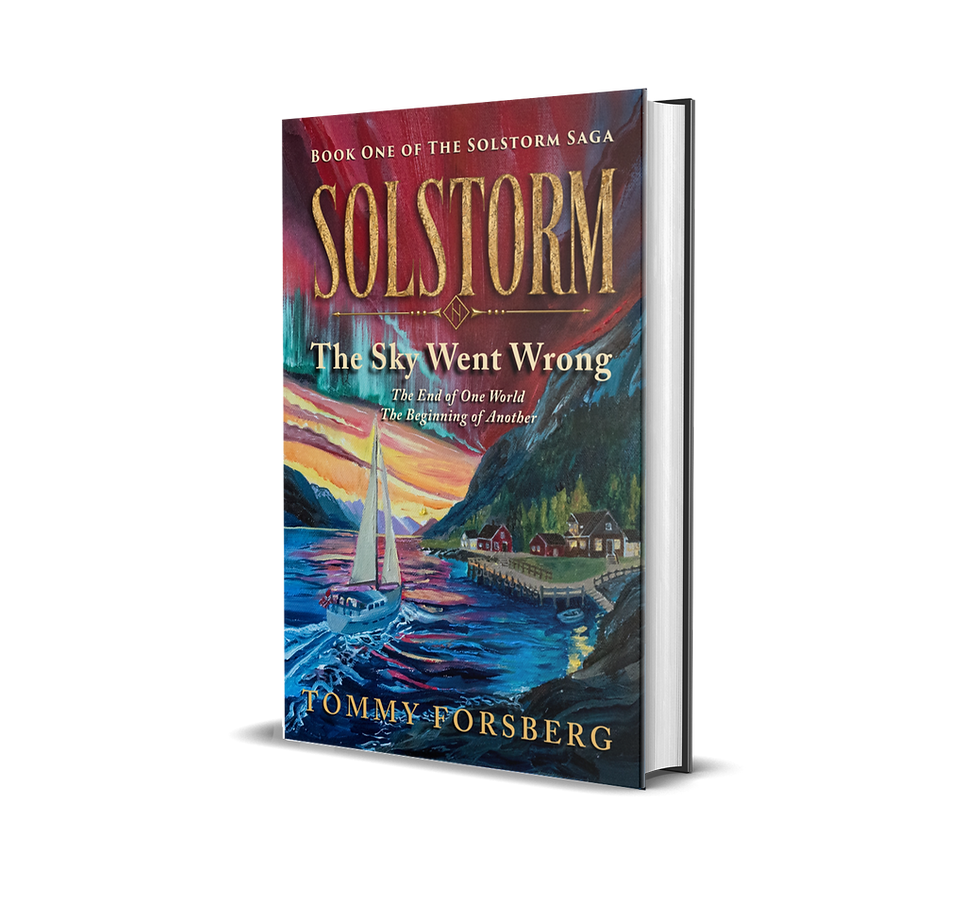
This is one of the questions that sits quietly beneath Solstorm.
Not only how people survive when the lights go out, but what kind of society begins to rise when survival is no longer enough. What sort of place a refuge becomes after the first urgency has passed. A harbor. A fortress. A fair settlement. Something harder. Something better. Or something worse.
So I am curious what you think.
If the old world fell away, and your community had to build something new, what would you choose first?
When survival is no longer enough, what should be built in its place?
Security first, strong walls and strict rules
A fair community built on cooperation
Local self-rule with as little central power as possible
A strong leader to keep order
The first struggle after collapse is staying alive.
The next is deciding what kind of people survive together.
That second question may matter even more.
-Tommy Forsberg