What a Solar Storm Would Really Do, and What It Wouldn't
- Tommy Forsberg
- Mar 19
- 5 min read

Would a solar storm change the weather, or just break the systems we rely on?

When people hear solar storm, they often picture the sky going mad. Strange lightning. Violent weather. The atmosphere deciding it wants to be the main character.
That is not what happens.
A severe solar storm does not attack rain, wind, or cold directly.
It strikes the invisible framework above us first: Earth's magnetic environment, the ionosphere, radio signals, satellites, navigation systems, and the electrical infrastructure modern life depends on so completely that most people never notice it until it starts failing.
And that is where it gets serious, especially in places like northern Norway.
A solar storm is not ordinary weather. It is space weather. Its first effects are not dramatic clouds rolling in over the horizon. They are failed signals, confused systems, unreliable radio, degraded navigation, and technology suddenly behaving like a man who is completely certain and entirely wrong.
The sky does not become fantasy.
It is worse than that. Nature stays perfectly real, while our ability to read it begins to slip.
First the signals fail
The Sun has more than one way to make trouble.
A solar flare can send intense X-rays toward Earth that disrupt the ionosphere almost immediately, particularly on the day side of the planet. High-frequency radio suffers first. A coronal mass ejection, or CME, can arrive later and trigger a geomagnetic storm. That disturbs Earth's magnetic field and upper atmosphere, affecting radio propagation, satellite navigation, spacecraft, and, in severe cases, power systems on the ground.
That sequence matters because it tells you what a serious event would probably feel like at the start.
Not cinematic. Just wrong.
The radio misbehaves. Navigation begins disagreeing with itself. Systems that normally line up stop lining up. Things may still function, but with that unpleasant half-working quality broken systems always have, where they keep talking just long enough to tempt you into trusting them.
That is how danger often arrives in a modern world: not with spectacle, but with uncertainty.
The magnetic field does not disappear
This is one of the most common misconceptions.
A solar storm does not switch off Earth's magnetic field. The planet does not suddenly lose its shield.
What happens is disturbance, not disappearance.
The magnetosphere gets compressed, shaken, and flooded with energy. Electrical currents intensify in the upper atmosphere. Auroral activity strengthens. Magnetic conditions become rough enough to create real effects both in orbit and on the ground.
The field remains. It just stops being quiet.
That may sound like a small distinction. It is not.
Quiet systems are easy to ignore. Disturbed systems begin causing trouble very quickly.
Does it directly change the weather?
Probably not in the way people usually mean.
A severe solar storm is best understood as a disruption of Earth's magnetic and upper-atmospheric environment, not as a rewrite of surface weather. It is not some cosmic hand reaching down to rearrange storm fronts for dramatic effect.
So if the question is whether a solar storm will directly create blizzards or strange new weather overnight, the careful answer is no, not in any clear or well-established sense.
But that does not make the weather question unimportant. It makes it more serious.
Because even if a solar storm does not directly create dangerous weather, it can make ordinary weather far more dangerous in practice.
A gale is one thing when the forecast is solid, the radio works, and navigation is dependable. It is another when warning systems are degraded and the tools you rely on are suddenly less trustworthy than the old fisherman who says he does not like the look of that sky.
The weather may be the same. Your position in relation to it is not.
Why the far north gets the sharper end of it
High latitudes are more exposed to auroral and ionospheric disturbance during major space-weather events. Radio, navigation, and related systems can be affected more severely in places already defined by long distances, rough weather, sparse infrastructure, and very little room for error.
A big city farther south may be badly disrupted. A northern coastal region may be partly cut off.
That is a very different kind of problem.
In places where sea, winter, darkness, and distance already make the rules, reliability is not a convenience. It is part of survival. Strip some of that reliability away, and the landscape starts feeling older almost at once.
Not because nature has changed. Because your buffer against it has thinned.
When the forecast becomes local again
Modern forecasting feels simple because most of us only see the end result: an app, a warning, a route adjustment. But forecasting is not magic. It is a chain.
It depends on satellites, timing systems, communications networks, data transfer, and people being able to move information from one place to another without too much failing in between.
If that chain begins to fray, the weather itself does not change. What changes is visibility.
You get less warning. Less certainty. Less confidence.
And that is when local knowledge starts mattering more again.
Seamanship matters. Barometers matter. Radio relays matter. Fishing communities matter. The old habit of actually looking at the sea and sky matters.
The forecast does not vanish. It just becomes human again, and far less smooth.
The first signs would feel wrong, not spectacular
That is probably the best way to imagine a severe event.
Auroras may appear far beyond where people expect them. Radio traffic turns erratic. Positioning systems drift. Familiar signals disappear. Equipment becomes temperamental. The silence where there should be routine traffic may be more unsettling than any dramatic noise.
At sea, that feeling sharpens.
A compass that seems unsure of itself. A radio that crackles oddly. Air that feels charged. Under the right conditions, even St. Elmo's Fire can feel less like folklore and more like a reminder that the world is electrical in ways most of us ignore until it starts behaving badly.
Not a Hollywood sky. A modern society becoming less sure of what it can trust.
The real menace
A severe solar storm does not need to make the weather stranger. It only needs to strip away the technical layer that helps modern people see, predict, coordinate, and recover.
The sea stays dangerous. The cold stays dangerous. The weather stays dangerous.
What changes is that the systems that once made those dangers legible begin to fail.
In a northern maritime setting, degraded radio, uncertain navigation, and weakened forecasting are not minor inconveniences. They reshape daily life very quickly. In places already shaped by water, weather, distance, and long winters, the loss of those tools does not feel like a technical problem. It feels like the return of something older.
In the end, a severe solar storm does not need to change the world.
It only needs to leave us more alone with it.
Sources
___
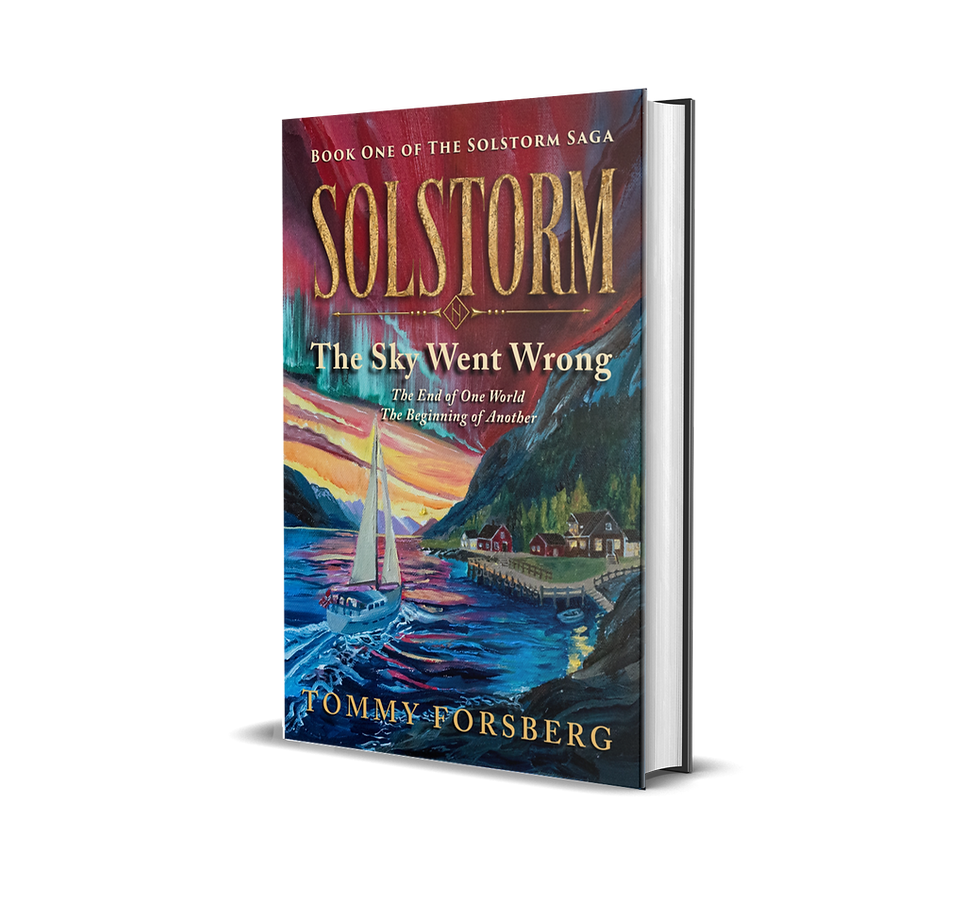
SOLSTORM
Book 1 launches September 1, 2026. A post-collapse world. A signal from the Arctic. A Norway that actually exists.
Join the signal at solstormsaga.com
What would concern you most in a severe solar storm?
Loss of radio and communications
Navigation and GPS failure
Power grid disruption
Losing reliable weather forecasts