Our King, and the Things That Hold a Country Together

Updated: Aug 28
This essay was written on the evening of 27 August 2026, while King Harald lay very seriously ill at Rikshospitalet. He died peacefully at 06:35 the following morning. I have left the essay as it was written.
I am writing this with tears running down my face.
King Harald of Norway is very seriously ill, and I am not sure people outside Norway can fully understand what that means to us.
The international news can report the facts correctly. Norway's 89-year-old King is in hospital. His condition is very serious. His family is close. Crown Prince Haakon is acting as Regent.
But those facts do not explain what is happening inside Norway.
People are crying.
Openly.
Because Harald is not simply our head of state.
For many of us, he feels like a father or grandfather. He has been there for most of our lives. He has stood with us when we celebrated, when we mourned, when we were frightened, and when we needed reminding that however much we disagreed, we were still one people.
He is part of the fabric of Norway. He is Norway.
He is the glue.
That may be difficult to understand from abroad, particularly because Norway is not a country naturally inclined toward reverence.
We distrust grandeur. We tease politicians. We are suspicious of anyone who takes himself too seriously. We are informal, egalitarian, sometimes stubbornly so.
And somehow Harald fits us perfectly.
He is unquestionably the King.
But he has always felt like one of us.
I met Harald when I was young.
And it has remained with me for almost forty years.
It was 1989. I was serving in the Norwegian Army, and Harald was still Crown Prince.
We were on a winter exercise in northern Norway. My platoon was in a forward position in the mountains. There were perhaps twenty of us. We had just established our camp under camouflage nets in the snow when a helicopter suddenly came in and landed close to our position.
We were ordered to line up.
Nobody told us who was coming.
We assumed it must be some senior officer inspecting the exercise.
Then the helicopter door opened.
And out stepped Crown Prince Harald.
Our mouths simply fell open.
He came walking toward us through the snow in full military uniform, four stars on his shoulders.
He was a big man. Tall. Imposing.
And then he reached the line. He went from soldier to soldier.
He stood perhaps two feet away and shook my hand.
I can still remember his face from that distance.
And I remember his hand.
Perhaps memories grow over nearly forty years, but I swear it felt as big as a frying pan.
At the time, he was the Crown Prince, the son of King Olav V.
Two years later, in January 1991, King Olav died.
I remember that too.
Norway mourned.
Not for a day. Not simply because protocol demanded flags at half-mast.
The country genuinely grieved.
People came to the Royal Palace with candles and flowers. Slottsplassen became a place of collective mourning. It felt as though someone in our own family had died.
King Olav had been known as Folkekongen, the People's King.
There is one photograph of him that almost every Norwegian knows.
During the oil crisis in 1973, Norwegians were being asked to leave their cars at home. King Olav wanted to go skiing.
So he took public transport. He walked from the royal palace down to the train station, carrying his own skis.
There he sits among ordinary passengers, dressed for a day outdoors, holding out a ten-kroner note to pay his fare. His adjutant had already paid for him.
A king on the tram, on his way to ski.
There is another famous story about Olav.
He was asked how he dared move around among ordinary people without enormous security.
He answered that he had four million bodyguards.
He meant us.
The Norwegian people.
Harald inherited that relationship.
But he did not simply inherit our affection from his father.
He earned his own.
For thirty-five years he has been our King, and one of the reasons we love him is that beneath the title, the medals, the uniforms and the ceremony, Harald has always allowed us to see the man.
His sense of humor is legendary.
It is not loud humor. He never needed to be the funniest person in the room.
His humor is dry, warm, mischievous and wonderfully self-deprecating.
He has always had an extraordinary ability to puncture ceremony with a single sentence.
There is a wonderful exchange involving his wife, Queen Sonja, and Norway's research station in Antarctica, which is called Troll.
Sonja had visited the station.
Harald asked her, on camera, apparently completely seriously, whether it had been named after her.
Sonja replied that no, of course it had not.
It was called Troll.
That is Harald.
The King of Norway teasing the Queen of Norway like any husband who has known and loved the same woman for most of his life.
He makes people laugh.
But perhaps more importantly, he makes people relax.
All the uniforms, guards, medals, protocol and ceremony can surround him, and then Harald grins and says something, and suddenly much of it disappears.
There is simply a man standing there.
Our Harald.
That humanity was visible again only recently, when Norway's men's national football team returned after their extraordinary World Cup run.
The players were received at the Royal Palace.
And even that reception says something about Norway.
One of the players arrived wearing sandals or flip-flops. Others came in shorts.
They were meeting the King.
Nobody seemed particularly bothered.
Harald himself was not sitting there covered in medals and ceremonial dress. He was in an ordinary shirt, tremendously proud to receive his boys.
And then came the moment that broke me.
The King became emotional.
Tears were running.
Ståle Solbakken, our national coach, stood in front of him. Ståle is a big man, and even with Harald partly sitting upright, his head was almost level with the King's.
Then Ståle simply reached out and put his hand on Harald's shoulder.
A small gesture.
An ordinary human gesture.
The sort of thing you do when your own father or grandfather becomes overwhelmed and you want to comfort him.
That was when my tears really came.
Because there was no sense of, "How dare you touch the King?"
Nobody recoiled.
Nobody seemed shocked by a breach of protocol.
We understood the gesture immediately.
It was affection.
Our national football coach comforting our elderly King because the old man was crying with pride for his boys and his country.
I can think of few images that better explain what Harald means to us.
There is another image that says something similar.
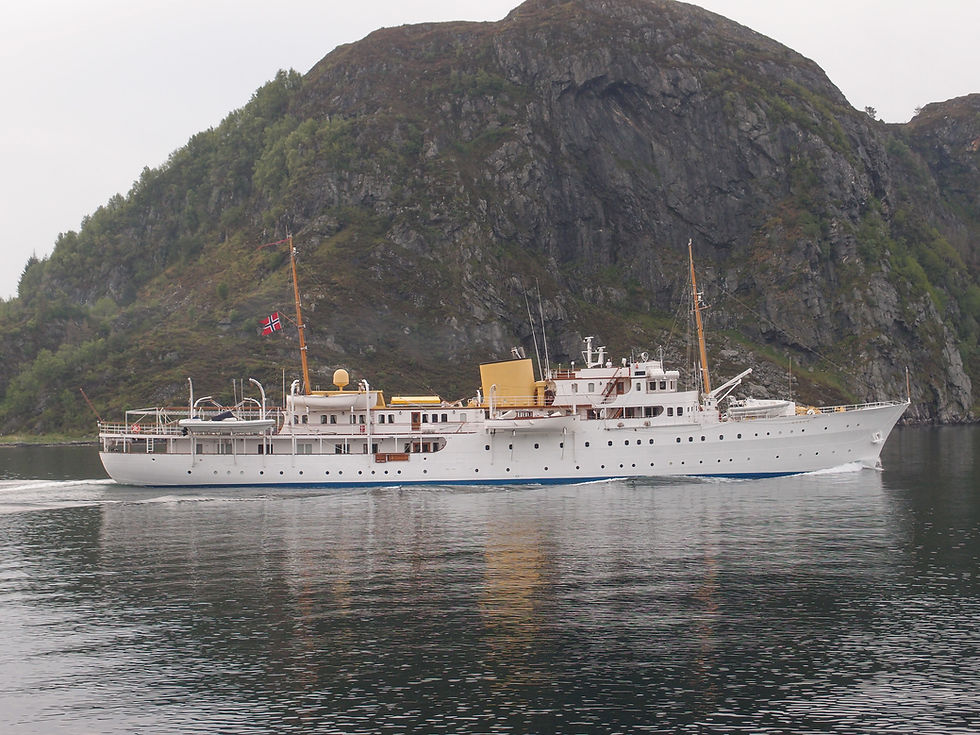
Every summer, the old white royal yacht appears somewhere along Norway's immense coastline.
Her name is simply:
Norge.
Norway.
That name matters.
She is not called after a king.
She is not named for a dynasty.
She is called Norway.
And she is old.
She was built in 1937.
The same year Harald was born.
Before she became our royal yacht, she served during the Second World War. After the war, money was raised throughout Norway to buy her as a gift to King Haakon VII.
The Norwegian people gave the ship to their King.
She was renamed Norge.
For generations since, that old white vessel has carried our Royal Family around the country.
Up fjords.
Along islands.
Into small ports.
North and south.
The King and Queen do not simply sit in Oslo and wait for Norway to come to them.
They go out and find Norway.
They visit small communities. They meet schoolchildren, fishermen, farmers, volunteers, municipal workers, elderly people and families.
And then Norge sails on toward the next town.
There is something deeply important about the ship being old.
This is not some modern billionaire's superyacht.
No vast glass palace designed to advertise wealth.
Norge is a ship from another time.
She is maintained.
Repaired.
Crewed.
Preserved.
And sailed.
A new yacht would communicate wealth.
Norge communicates continuity.
As a seaman myself, perhaps that affects me more deeply than it might affect others.
An old vessel that is cared for and kept alive instead of being discarded for something newer has meaning.
Every summer, that old ship called Norway carries the King back out among the people whose grandparents helped give her to his family in the first place.
There is something beautiful about that.
And beside Harald has always been Sonja.
Queen Sonja is another part of this national relationship.
She has spent decades walking Norway.
Not posing beside mountains.
Walking them.
Norwegians have a phrase that is difficult to translate properly into English:
gå på tur.
It means to go for a walk or a hike, but it means more than that.
It is almost a cultural instinct.
You put on your boots.
You go outside.
Into the mountains, forest, snow, along the shore or across the plateau.
You walk.
Sonja has embodied that part of Norwegian life for decades.
She has crossed mountains and followed trails throughout the country. She became known as Turdronningen, the Hiking Queen.
Again, there is something important in that.
Our Queen does not merely admire Norway from a palace window.
She walks through it.
And perhaps this leads to something larger I have been thinking about today.
How does a country remain a "we"?
Norway is long.
Very long.
People sometimes forget that.
From the southern end to the far north is an enormous distance. Communities are separated by mountains, fjords, islands and weather. Oslo can feel very far away from Finnmark or northern Troms.
We have political disagreements.
We have urban and rural tensions.
We have left and right.
We have old Norwegians and new Norwegians.
Christians, Muslims, atheists.
People whose families have lived here for centuries and people who arrived recently.
We argue.
But underneath all of that are things that continually remind us that we belong to the same place.
The King does that.
The Royal Family travelling through the country does that.
And, strangely enough perhaps to an American reader, television does some of it too.
Norway has NRK, our publicly funded national broadcaster.
It is paid for collectively and has a public-service responsibility to cover the whole country, not merely the capital or the places where the largest advertising market happens to be.
For decades, one of Norway's most beloved television programmes has been Norge Rundt.
The title means something like "Around Norway."
And what does it show?
Mostly ordinary people.
Someone repairing an old fishing boat.
A farmer.
A strange local tradition.
An elderly craftsman.
Children in a tiny village.
Someone with an eccentric hobby.
Animals.
Snow.
Mountains.
A little community somewhere you may never have visited.
Nothing spectacular has to happen.
That is almost the point.
For fifty years, Norwegians have sat down on Friday evenings and watched other Norwegians simply living their lives.
A family in Oslo sees a fisherman in Finnmark.
Someone in Bergen sees life in an inland valley.
Someone in Tromsø sees a small community in southern Norway.
We see one another.
That matters more than we perhaps realize.
And it makes me think about America.
Harald himself has a deep connection to the United States.
He was only three years old when Nazi Germany invaded Norway in 1940.
His mother, Crown Princess Märtha, fled with Harald and his sisters.
Eventually they came to America.
President Franklin D. Roosevelt opened the door to them.
The future King of Norway spent five childhood years living in the United States while his own country was occupied.
Roosevelt was not simply some distant American president in a history book to Harald.
He was part of Harald's childhood world.
Harald was present at the White House when Roosevelt took his fourth presidential oath in 1945.
Think about that image.
A small Norwegian refugee boy standing in America while his country remained occupied, watching the President of the United States take the oath of office as the greatest war in human history approached its end.
Harald never forgot what America gave his family.
And he never forgot what America meant to Norway.
Many decades later he said something that I wish more Americans knew:
"Wherever life takes me, I will always take a piece of America with me in my heart."
There is something I think America, particularly the America of today, might find worth considering in the country Harald came home to lead.
I am not saying America needs a king.
America is America. Its history and traditions are its own.
But the United States combines political leadership and national representation in the presidency.
A president must win.
He must defeat somebody.
Almost half the country may have voted against him.
That makes it extraordinarily difficult for any American president to become a truly apolitical father or mother figure to the whole country.
Norway separates those roles.
Our governments govern.
Politicians fight elections.
Prime ministers come and go.
The King does something else.
He belongs to everybody.
Harald does not need to persuade Labour voters to defeat Conservatives, or Conservatives to defeat Labour.
He does not need to win one half of Norway against another.
He can simply remind us:
You are Norwegians.
You still belong to one another.
That does not solve political disagreement.
It does not make Norway perfect.
Far from it.
But I increasingly think modern democracies need institutions that do something other than divide people into winning and losing camps.
People need places where they can still see each other.
They need shared stories.
Shared rituals.
Shared institutions.
A national broadcaster that shows ordinary people from every corner of the country.
An old Queen walking through the mountains.
An old white ship called Norway entering another fjord.
A King who can make a room full of nervous people laugh.
A King who cries when his football team comes home.
A football coach who instinctively puts his hand on the King's shoulder because, for one second, he is not comforting a monarch.
He is comforting an old man he loves.
Our King.
I keep coming back today to that young soldier standing in the snow in northern Troms almost forty years ago.
A helicopter lands.
Twenty young men line up expecting some senior officer.
The door opens.
Out walks Crown Prince Harald.
He approaches us through the snow.
Then suddenly he is standing directly in front of me.
Close enough that I can see his face.
He reaches out that enormous hand.
I had no idea then how much that man would eventually mean to my country.
I could not have imagined that thirty-seven years later I would sit here writing through tears because he was lying seriously ill in a hospital.
The international media can say:
"Norway's 89-year-old King is very seriously ill."
That statement is true.
But there is another truth that does not fit easily into a headline.
Someone we love is in that hospital.
Someone who has spent decades reminding five million very different people that we are still a "we."
Our sailor.
Our soldier.
Our comedian.
Our grandfather.
Our King.
Harald.
Why does this hurt so much?
Because he has helped make us feel like one people.